

Guided by Vision 2030, labor market reforms are picking up pace and the Ministry of Human Resources and Social Development (HRSD) has transformed the corporate environment from legacy sponsorship models to an increasingly regulated contract-based model. Managing iqama transfer rules in Saudi Arabia workflow is a fundamental operational need for multinational enterprises and growing firms. These talent transitions are now completely handled via the state-backed Qiwa online platform.
If your corporate HR process does not align with current regulatory standards, failure to achieve on-board timing can stall the onboarding process, lock visa quotas, and raise compliance penalties. This is an operational manual covering contemporary legal obligations, company liabilities, and procedural flows for global mobility heads and local corporate experts.
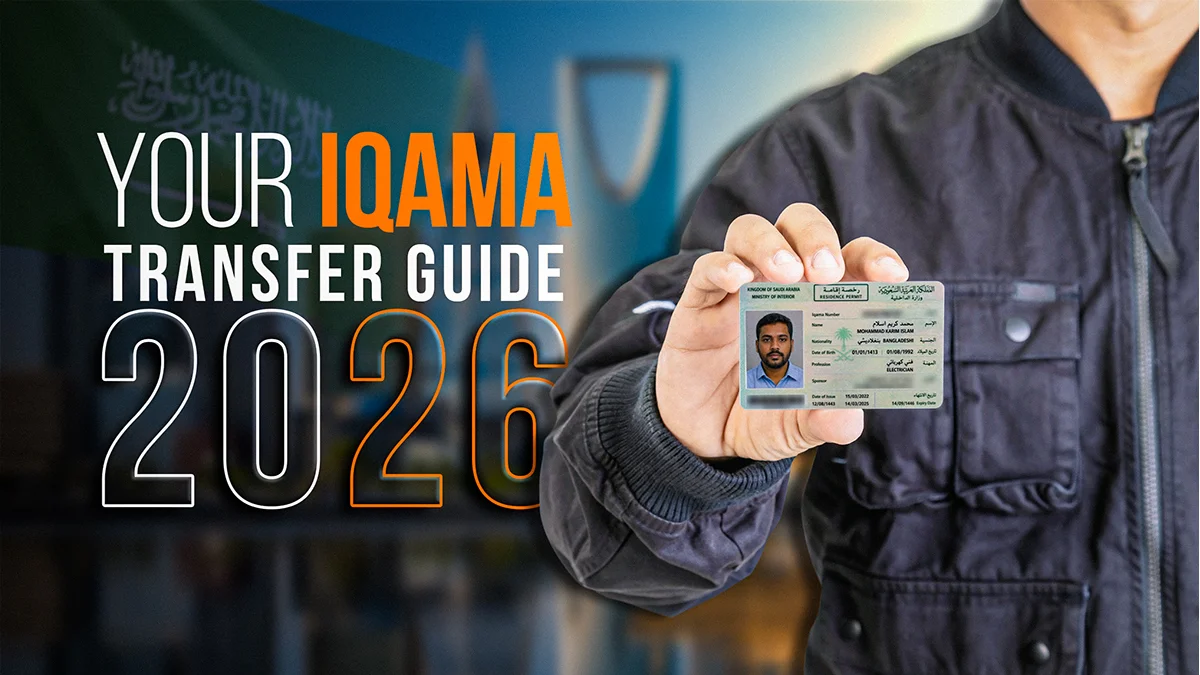
Focusing on a statutory resident identification framework is essential for global mobility teams before deploying capital or organizing a localized talent acquisition campaign. To serve the basis of compliance question — what is iqama? — It is the legally required residence identification card for expatriates working inside the Kingdom.
The physical card serves as a document for several years and is valid for five. But the bases of both — digital residency status and work permits — are separately enforced and need to be completed on a yearly or quarterly basis through Muqeem or Absher Business.
The standard document contains essential regulatory data points that outline the parameters of an expat’s operations. Included in these fields are the legal name, a ten-digit exclusive tracing number at an individual and national level alongside the enlisted calling (Mehna). Under active labor policies, a worker’s physical work must fit this registered profession without miss. Any day-to-day business activities differing from the official activity on iqama attracts hefty municipal fines and demotion in the Nitaqat category.
Based on the way a foreign national enters, their remuneration level and or rank in a corporation, the Kingdom grants specific residency classes. Identifying the various types of iqama in saudi arabia within your existing or potential talent pool helps to ensure compliance mapping and means obtaining an ideal operational levy estimate.
Executing an iqama transfer is no longer an intentional agreement of corporate active clients. There, HRSD’s up-to-date make-up safeguards labor fluidity while still maintaining the legal entitlements of the contracting business.
A professional can progress to your enterprise under normal operating conditions if they have served a minimum of 12 months active service with their existing sponsor. The process includes an actual job offer that you need to initiate on the Qiwa digital platform with your HR team followed by an electronic signature from the candidate. Once the offer is accepted, it notifies the employer being worked at and he has a normal notice period based on his contract which can go up to 90 days.
Under the HRSD policy, an expat working in the Kingdom will be able to directly switch from its current sponsor and join your company immediately only if certain operational failures occur:
All sponsorship iqama transfer steps should be made by your Government Relations Officer (GRO) or corporate HR specialist directly through the verified Qiwa business dashboard of your company. Do this to undertake a compliant and timely transfer exactly with the following technical sequence:
1.Process the Job Offer and Finalize it:1-3 Working Days.
The first option is to log in to the corporate business portal of Qiwa and then to go to the Employee Transfer service, where the candidate’s residency number must be entered. Prepare a simple electronic employment agreement indicating the exact title of the job in Saudi Standard Classification of Occupations, Basic Salary and Duration of Contract.
2.Secure Employee Digital Acceptance:10-Day System Window.
The candidate receives an automated notification on their personal Qiwa account to review the pending job offer. Premium Residency (Self-Sponsored) Specifically for Ultra High Net-Worth Individuals and Executives & Exceptional Skilled Migrants.
3.Trigger Current Sponsor Notification:14-Day Response Window.
Upon candidate signature, Qiwa transmits a digital notification to the current employer. The current sponsor has 14 days to acknowledge the transfer, and the system automatically tracks any contractually mandated 90-day notice periods.
4.Settle Government Transfer Fees: Immediate Execution.
Access your corporate banking portal and navigate to the SADAD payment gateway under government services. Process the required non-refundable sponsorship transfer fee utilizing your company’s unique establishment ID.
5.Finalize the Muqeem Data Sync: 3-7 Working Days.
Log into your corporate Muqeem or Absher Business dashboard to execute the final transfer step. The system will sync the verified Qiwa data, update the employee’s sponsorship record under your corporate entity, and generate a digital reference proof.
Under Article 40 of the Saudi Labor Law, the incoming employer must bear all government fees related to a professional’s recruitment and sponsorship transfer. Passing these costs onto the employee via payroll deductions is a direct violation of compliance standards.
The statutory transfer pricing model increases progressively based on the number of times the specific individual has shifted sponsors within the Kingdom:
Above the base transfer fee your finance teams will need to factor in additional operational costs on a monthly basis. This includes the normal Work Permit Levy which is up to 800 SAR per month for every expat worker based on your local Saudi-to-foreign staffing ratios, together with compulsory GOSI social insurance contributions.
If you are working on cross border talent acquisition or a local transition in Saudi Arabia there is no room for error. Large pieces that are missed in compliance lead to friction in processing or administrative time after the event.
For instance, if your corporate entity sees itself registering in one of the lower tiers of the Nitaqat Saudization framework, you will be unable to transfer-explore a talent either in or out of your enterprise. A hiring company must be a Medium green or higher before being able to poach talent away from another employer. If your Saudi hiring ratio drops below that of your sector, Qiwa will actively block any requests from you immediately.
Validating the employee is clean with respect to regulation before starting an onboarding sequence is key. The mere existence of ongoing, non-adjudicated labor court cases, exit-reentry violations or unpaid traffic fines associated with the candidate’s ID number at the time of application will put a freeze on the transfer pipeline. The platform shall not finalize until each remaining legal liability is in writing and formally settled.
When the labor contract of an expatriate expires, there is a strict 60-day grace period by HRSD. During this period, the worker needs to either complete a transfer to a new licensed sponsor or obtain a Final Exit Visa to depart the Kingdom. However, if your team does not complete the 60-day countdown before somebody completes the digital Qiwa and Muqeem onboarding steps, his or her residency status goes non-compliant immediately which means that your firm may be subject to structural penalties.
At Trek Consultancy, we provide end-to-end support for company incorporation in Saudi Arabia.
Investment Consultancy: Professional guidance on Saudi investment laws and foreign ownership regulations.
Company Registration: Complete support for
PRO Services: Government relations and documentation management including
Legal Translation Services – Certified Arabic and English translations for official government submissions.
HR & Compliance Support: We help businesses comply with
Accounting & Tax Support: Support for
Office & Ejar Support: Assistance with
Trek Consultancy provides reliable and professional company formation services tailored for foreign investors.
We help simplify every stage of setting up a business in Saudi Arabia.
Yes. An employee is entitled to transfer to a legal company if the employer does not renew his residency permit in accordance with the statutory deadlines. Qiwa Agreement allows a new employer to submit the same process without needing any consent from the current employer’s portal.
No. The legacy NOC framework which was paper-based has been replaced with the digital Qiwa ecosystem. The contract termination or the standard transfer, both completed and approved through the portal, constitutes the only official legalized authorization for change of employer.
It is not recommended. At a technical level, real-time data synchronization is needed between Qiwa, Absher and Muqeem to enable shifting sponsorship. If you have an active exit-reentry visa and plan to leave the country while a transfer window is open, misalignment of data will create lock issues in the portal file, prompting your team to either cancel or rebuild the application.
Your trusted partner for Saudi business setup, MISA licensing, software development, real estate investment, visa services, and international company formation. We help investors and businesses grow with end-to-end professional solutions.
